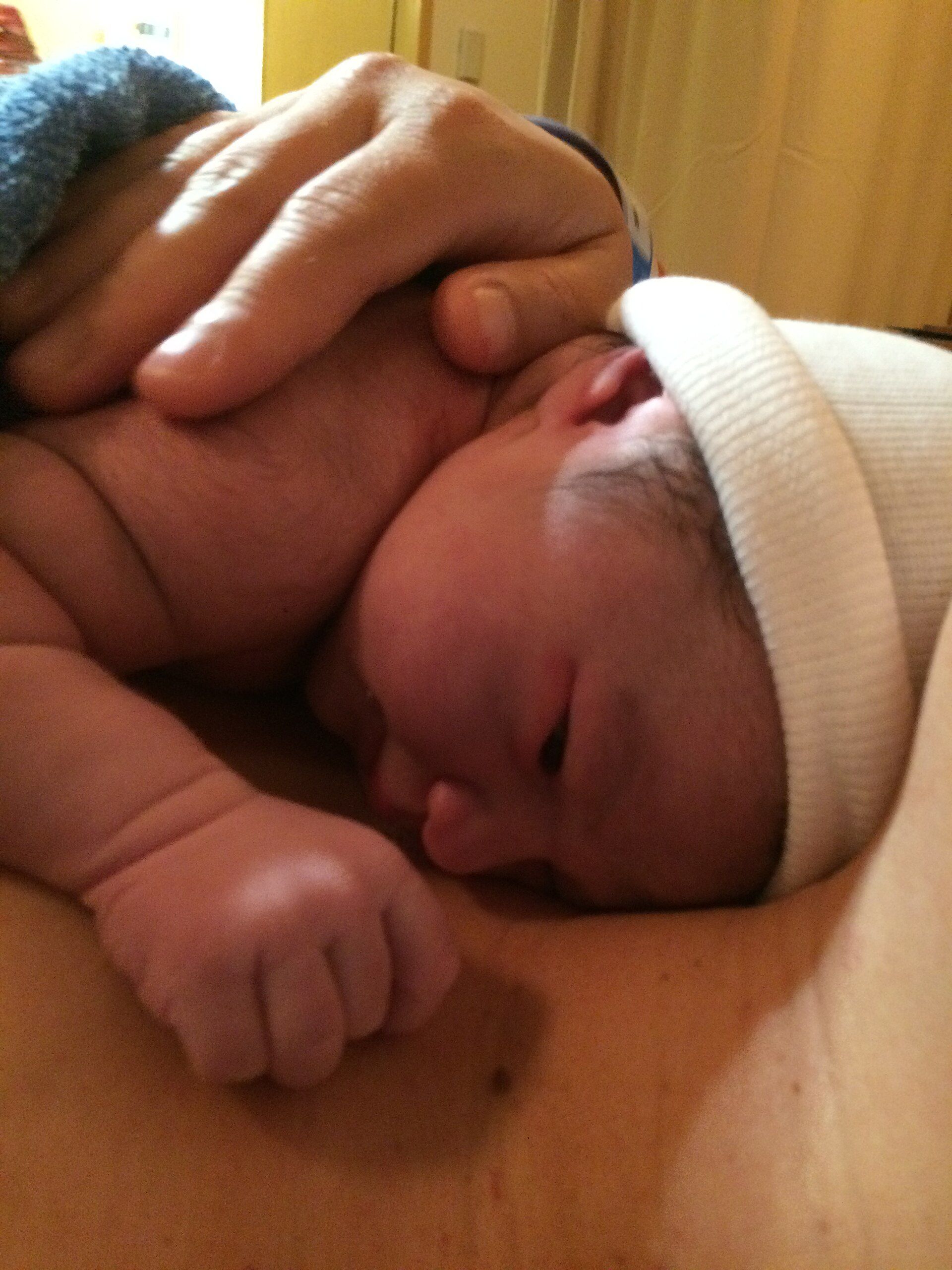
Which signs suggest a sucking difficulty?
Some signs come up often when a baby struggles to feed:
- they come off the breast often, get frustrated or fall asleep very quickly;
- you hear clicking or unusual sucking noises;
- feeds are very long or very frequent, without the baby seeming satisfied;
- feeding hurts, with sore nipples or cracks.
Some tenderness is common in the first days. Pain that lasts or gets worse is not normal and deserves a closer look.
How can osteopathy help?
To feed well, a baby needs to open their mouth wide, place their tongue under the breast, coordinate sucking, swallowing and breathing, and be able to turn their head to both sides. Birth can leave tension behind: a long or very quick labour, a particular position in the womb, an assisted delivery. This tension can get in the way of one of these movements, and feeding becomes difficult or painful.
What I look at
- how your baby opens their mouth and moves their tongue;
- the mobility of their jaw and neck, and whether they can turn their head to both sides;
- their overall posture: a baby who arches or always lies the same way often feeds less well;
- if possible, a feed, to see how it all comes together.
What I work on
With very gentle techniques suited to newborns, I work on tension in the mouth, jaw, neck and skull, and on your baby’s overall posture. The aim is for them to open their mouth wider, place their tongue better and settle comfortably at the breast.
What you can expect
When tension is getting in the way of sucking, the aim is for feeds to become more effective and less painful, especially when position is adjusted at the same time with the midwife or lactation consultant. I also give you pointers for feeds and positions at home.
Trained in paediatric and perinatal osteopathy (CES, 2016), then in 2025 in the multidisciplinary care of sucking disorders and oral ties, I work closely with breastfeeding professionals and refer you to the doctor if anything calls for it.
Painful breastfeeding: is it the baby?
Often in part, but not always. The most common cause is the baby’s position and latch: according to the French National Authority for Health, sore and damaged nipples are mainly due to a poor latch. A good position, with the mouth wide open and the tongue down, allows effective sucking.
On the baby’s side, less effective sucking can keep the pain going: a mouth that doesn’t open wide, a tongue that is poorly placed, a head that struggles to turn one way. This is the tension osteopathy can help with.
On the mother’s side, other causes need checking by the midwife or doctor: engorgement, infected cracks, mastitis (a red, hot, painful breast, often with fever).
Other factors can play a part: a difficult start, tiredness, milk coming in late. A short tongue tie can sometimes get in the way of sucking. It is far from the most common cause, and the French National Academy of Medicine points out that a short or thick frenulum does not, on its own, justify surgery.
Who should I see, and in what order?
Start with breastfeeding professionals:
- your midwife, or the maternity unit’s midwife;
- a lactation consultant, who watches a feed and adjusts position and latch;
- the paediatrician or family doctor, to check your baby’s weight and rule out a medical cause.
If a tongue tie is mentioned, any decision about a frenotomy is made with the doctor or paediatrician, after the baby’s sucking has been assessed.
And for the mother?
Difficult breastfeeding is tiring. The mother + baby option lets me see the mother and her baby under one year in the same visit, as two consultations in a row.
At the practice
I see your baby with you, without rushing. We start by talking about the pregnancy, the birth and how feeds are going. I then observe your baby: posture, movements, mouth and sucking. The techniques are gentle and suited to their age, and you stay beside them throughout. At the end, I explain what I noticed and, if needed, refer you to your midwife, lactation consultant or paediatrician, with whom I work closely.
Frequently asked questions
Should I stop breastfeeding if my baby feeds badly?
Not necessarily. Most breastfeeding difficulties can be supported without stopping. Talk to your midwife or a lactation consultant before making any decision.
Can an osteopath see a newborn?
Yes, from the first days of life. The techniques are gentle and suited to their age, and you stay with your baby throughout the session.
How many sessions will we need?
It depends on the baby and the situation. We review things together at the end of each session and decide whether it would help to see your baby again.
Is it reimbursed?
Most top-up insurers (mutuelles) and many international insurers cover part of the cost of osteopathy: check with yours. The French national health insurance (Sécurité sociale) does not reimburse it.
Sources
- HAS (French National Authority for Health) – Breastfeeding: getting started and continuing in the first 6 months (in French)
- French National Academy of Medicine – Putting the brakes on tongue-tie surgery in newborns and infants (April 2022, in French)
Page updated on 11 October 2026.